Install a Zano CLI Wallet (Linux)
Download Zano, extract the CLI binaries, sync the blockchain, and create your first wallet.
1. Download
Go to zano.org and navigate to the downloads section. Download the Linux release; it's distributed as an AppImage file:
zano-linux-x64-release-v<VERSION>[<hash>].AppImage
2. Verify the download
Open a terminal in the download directory and run a checksum against the file:
sha256sum zano-linux-x64-release-v*.AppImage
Compare the output against the SHA256 hash published in the release notes. If they don't match, re-download the file.
You can launch any executable included in the AppImage without extracting it, for example, start the daemon with custom arguments:
chmod +x zano-linux-x64-release-v*.AppImage
./zano-linux-x64-release-v*.AppImage \
  --exec="zanod" \
  --exec-args="--log-level=2 --rpc-bind-port=11212"
To launch the CLI wallet:
./zano-linux-x64-release-v*.AppImage \
  --exec="simplewallet" \
  --exec-args="--generate-new-wallet name.wallet"
3. Extract the CLI binaries
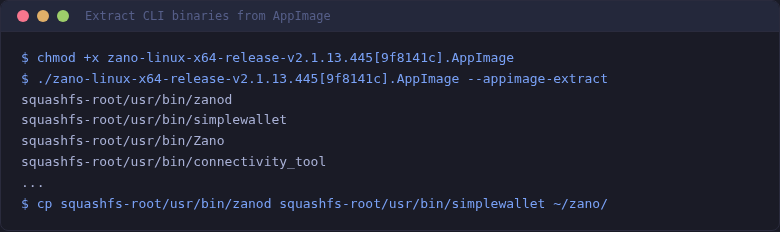
The AppImage contains both the GUI wallet and CLI tools. To extract the CLI binaries:
chmod +x zano-linux-x64-release-v*.AppImage
./zano-linux-x64-release-v*.AppImage --appimage-extract
This creates a squashfs-root/ directory. The CLI binaries you need are inside:
squashfs-root/usr/bin/zanod          # the daemon (node)
squashfs-root/usr/bin/simplewallet   # the CLI wallet
Move them to a directory of your choice:
mkdir -p ~/zano
cp squashfs-root/usr/bin/zanod squashfs-root/usr/bin/simplewallet ~/zano/
You can delete squashfs-root/ after copying the binaries.
4. Start the daemon
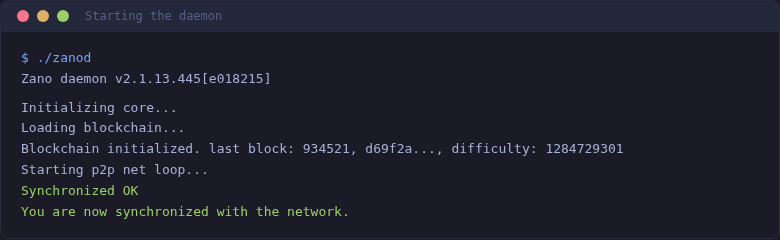
The daemon (zanod) connects to the Zano network and downloads the blockchain. Open a terminal in your Zano directory and run:
./zanod
Wait for the blockchain to fully sync; the first run can take a few hours, depending on your connection speed. Keep the daemon running; you'll need it for the next step.
If you don't want to download the full blockchain, you can connect your wallet directly to a public node instead. Skip to step 5 and add --daemon-address when opening your wallet:
./simplewallet --generate-new-wallet name.wallet --daemon-address 37.27.100.59:10500
See Public Nodes for available endpoints.
5. Create a new wallet
Once the daemon is synced (or if you're using a public node), open a new terminal in the same directory:
./simplewallet --generate-new-wallet name.wallet
Replace name with whatever you'd like to call your wallet (e.g., mywallet.wallet).
You'll be prompted to create a password. Use a strong one; a password manager like KeePass or Bitwarden helps.
After the password is set, the wallet will display your receive address (starts with Zx). This is the address you'll use to receive ZANO.

6. Back up your seed phrase
Your seed phrase is the only way to recover your wallet if you lose the wallet file or forget the password.
Inside the wallet console, run:
show_seed
You'll be prompted for your wallet password, then asked to set a seed password (also called a passphrase). This is optional. If you set one, you'll need both the seed phrase and the passphrase to restore the wallet.
The wallet will display your seed phrase (26 words for current wallets). Write it down and store it somewhere safe and offline.

Anyone with access to your seed phrase (and passphrase, if set) can take full control of your wallet. Never share it, never store it digitally in plain text.
7. Open an existing wallet
To reopen your wallet in the future:
./simplewallet --wallet-file name.wallet
Enter your password when prompted.
You're done. Head over to Using a Zano CLI Wallet for sending, receiving, and more advanced operations.