Keeping Your Wallet's UTXO Set Healthy
If you run a Zano wallet that processes many transactions (an exchange hot wallet, a payment processor, a high-volume merchant, or simply an individual who has received many small payments over time), your wallet's UTXO set can drift toward an unhealthy shape: lots of small UTXOs and very few large ones.
When this happens, building a large outgoing transaction has to gather many small UTXOs, and eventually hits one of two hard limits:
- The maximum number of inputs per transaction.
- The maximum transaction size on the network.
At that point, large withdrawals start failing, even though the wallet balance is plenty to cover them.
This guide explains how to inspect and maintain a healthy UTXO distribution using two wallet RPC methods.
1. Why UTXO shape matters
Your wallet's coin-selection logic prefers to spend the smallest UTXO that can cover the amount being sent. When that doesn't exist, it falls back to combining several. As a rule of thumb:
- Few large UTXOs → any withdrawal (small or large) uses just 1–2 inputs. Transactions stay small, cheap, and reliable.
- Many small UTXOs → small withdrawals work, but large ones balloon to hundreds of inputs and eventually fail.
The goal of UTXO maintenance is to keep the wallet biased toward the first shape.
2. Inspect: get_utxo_stats
The
get_utxo_stats
wallet RPC returns a histogram of your current UTXOs by amount. This is
the right starting point: run it before doing anything else, so you know
whether maintenance is actually needed.
A typical "unhealthy" output shows tens of thousands of UTXOs concentrated in the low buckets (e.g. under 10 or under 100 coins), with only a handful in the higher buckets. A typical "healthy" output shows a small total count (tens, not thousands) with most of the balance in the largest bucket.
You can call get_utxo_stats periodically as a monitoring signal:
if the count of UTXOs below your target threshold grows past a few
hundred, schedule a maintenance run.
3. Consolidate: sweep_below
The
sweep_below
wallet RPC is the right tool to fix an unhealthy distribution. It:
- Collects every spendable UTXO whose amount is less than the
amountthreshold you pass in. - Sorts them biggest first and bundles them into a single transaction that sends the consolidated total back to the address you specify (typically your own wallet address).
- The result: many small UTXOs in → one large UTXO out, per transaction.
sweep_belownow supports assets. Use theasset_idfield to consolidate balances of a specific confidential asset; omit it to consolidate the native ZANO balance. See thesweep_belowreference for the full parameter list.
A single sweep_below call produces one transaction. Because each
transaction has a maximum input count, you usually need a series of
calls to fully normalize a wallet that has drifted badly.
4. Recommended procedure
Run the following procedure when get_utxo_stats shows an unhealthy
distribution:
Parameters
| Parameter | Recommendation |
|---|---|
amount (threshold) | 5000 coins for wallets with significant balance. If your total balance is low (e.g. under ~50,000 coins), use a smaller threshold so that consolidation still leaves you with multiple usable UTXOs; a good rule is threshold = balance / 10, capped at 5000. |
address | Your own wallet's primary address; you are consolidating into one new big UTXO for yourself. |
mixin | Use the standard value of 15 decoys, which produces a ring size of 16 for each input after the real output is included. |
fee | The current network minimum fee (0.01 ZANO at time of writing). |
asset_id | Omit for native ZANO. Set explicitly when consolidating a specific asset. |
Pacing
-
Do not run more than 10
sweep_belowtransactions in a single batch. Beyond that you risk overloading the daemon, conflicting with normal traffic, and producing more unconfirmed transactions than the network is ready to process. -
Wait at least 30 minutes between batches. Thirty minutes is enough for the previous batch's transactions to confirm so the next batch starts from a clean, observable wallet state. If you don't wait, your wallet's coin-selection sees temporarily-locked inputs and may produce conflicting consolidations.
-
Stop when there is nothing left to sweep. Each
sweep_belowresponse includes two counters:outs_total: the total number of UTXOs below the threshold that the wallet found.outs_swept: how many of them were actually consolidated into the transaction that was just built.
When
outs_swept == outs_total, the wallet swept every sub-threshold UTXO in a single transaction; there is nothing left to consolidate and you should stop callingsweep_belowuntil more small UTXOs accumulate (typically the next maintenance window). -
Treat a
sweep_belowerror the same way. If the call returns an error (for example because there are no spendable sub-threshold outputs left, or none that satisfy the mixin requirement), the wallet has nothing to sweep, so stop the current batch. -
After each batch, call
get_utxo_statsagain to check progress. Stop when the low-bucket count is under a few dozen.
Pseudocode
threshold = min(5000, total_balance / 10)
hot_addr  = "<your wallet primary address>"

while True:
    stats = rpc.get_utxo_stats()
    if stats.utxos_below(threshold) <= TOLERANCE:   # e.g. 30
        break                                       # we're healthy

    done = false
    for i in 1..10:                                 # at most 10 per batch
        try:
            resp = rpc.sweep_below({
                mixin:    15,
                address:  hot_addr,
                amount:   threshold,
                fee:      MIN_FEE,
            })
        except RpcError:
            done = true                              # nothing left to sweep
            break

        if resp.outs_swept == resp.outs_total:
            done = true                              # everything below threshold
            break                                    # was consolidated in one tx

    if done:
        break                                        # full normalization complete
    sleep(30 minutes)                                # let txs confirm before next batch
Frequency
For wallets that are heavily used (multiple withdrawals per hour), schedule this procedure to run daily during a low-traffic window. For wallets that are mostly idle, weekly is plenty.
If your wallet is severely unhealthy when you start (tens of thousands of small UTXOs), the first full normalization will take many batches, possibly spread over several days at the 10-per-30-min pacing. After that, daily/weekly maintenance keeps it healthy with very little work.
5. Example: how many transactions does it take?
To give you a realistic picture, the chart below shows a simulation starting from a deliberately unhealthy distribution:
- 10,000 UTXOs of less than 10 ZANO
- 1,000 UTXOs of 10–100 ZANO
- 100 UTXOs of 100–1,000 ZANO
- 10 UTXOs of 1,000–50,000 ZANO
(Total: 11,110 UTXOs, ~470,000 ZANO balance.)
Six different threshold choices were simulated. For each, the chart shows
the resulting UTXO histogram and how many sweep_below transactions
were needed to get there.
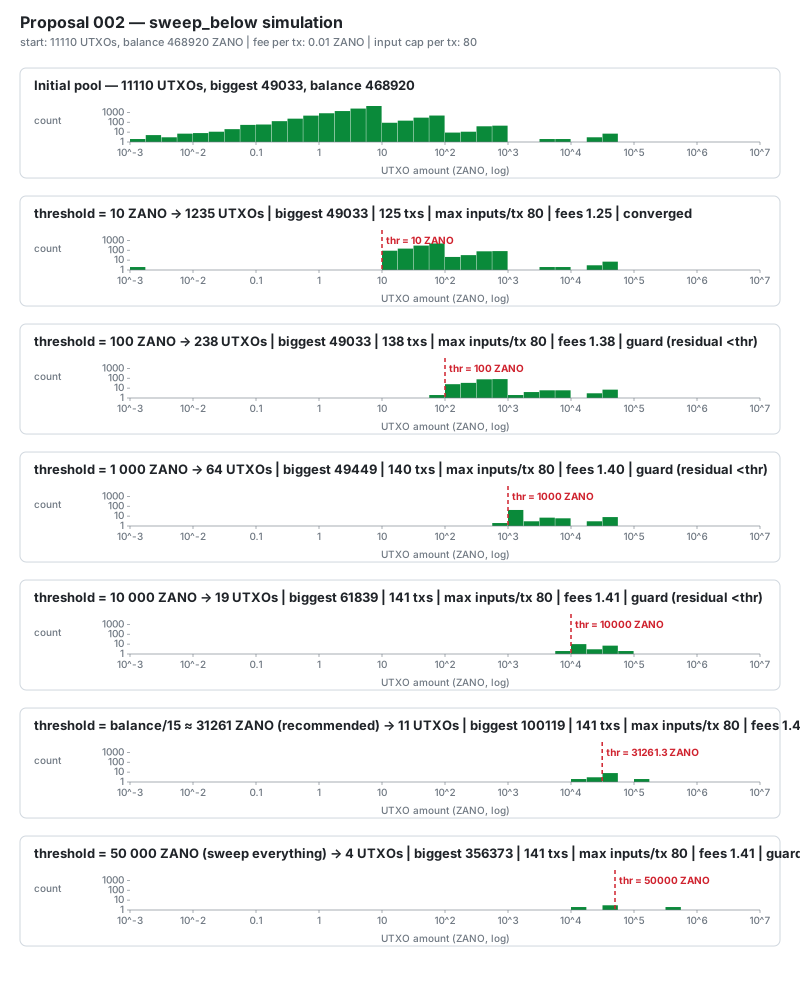
Reading the numbers
| Threshold | Final UTXO count | Biggest UTXO | Transactions needed |
|---|---|---|---|
| 10 ZANO | 1,235 | 49,033 | 125 |
| 100 ZANO | 238 | 49,033 | 138 |
| 1,000 ZANO | 64 | 49,449 | 140 |
| 10,000 ZANO | 19 | 61,839 | 141 |
| 31,261 ZANO (≈ balance ÷ 15) | 11 | 100,119 | 141 |
| 50,000 ZANO (sweeps everything) | 4 | 356,372 | 141 |
A few observations:
- Total transaction count is roughly the same (125–141) regardless of threshold. The work is dominated by draining the ~10,000 tiny UTXOs through the per-transaction input cap.
- Higher thresholds give you fewer, larger output UTXOs, i.e. a healthier-looking end state.
- Aggressive thresholds (sweep everything) collapse the wallet to very few outputs (3–4), which works but sacrifices the ability to run many withdrawals in parallel. The "balance ÷ 15" zone is a good middle ground.
- At the recommended 10-tx-per-30-min pacing, the full normalization in this example takes about 141 ÷ 10 = 14 batches, i.e. about 7 hours of clock time. After that, daily maintenance with the same procedure keeps the wallet healthy with only a few transactions per run.
6. Quick reference
| Action | RPC method | When |
|---|---|---|
| Check current UTXO distribution | get_utxo_stats | Always run first; also use for monitoring |
| Consolidate small UTXOs | sweep_below | When small-bucket count grows past a few hundred |
Rules of thumb
- Threshold: 5000 coins for high-balance wallets;
balance ÷ 10capped at 5000 for smaller wallets. - Batch size: at most 10
sweep_belowtransactions in a row. - Pacing: wait at least 30 minutes between batches.
- Stop condition: when
outs_swept == outs_totalin asweep_belowresponse (or the call returns an error); the wallet has nothing more to consolidate. - Cadence: daily for busy wallets, weekly for quiet ones.
- Assets: pass
asset_idtosweep_belowto consolidate a specific confidential asset; omit it for native ZANO.
A healthy wallet is one where any reasonable withdrawal, small or large, can be built from 1–2 inputs. Running this procedure on a regular schedule keeps it that way with minimal overhead.