Signing transactions offline (cold-signing process)
Introduction
In order to provide more security it's possible to sign transactions offline using a dedicated wallet application instance e.g. running in a secure environment.
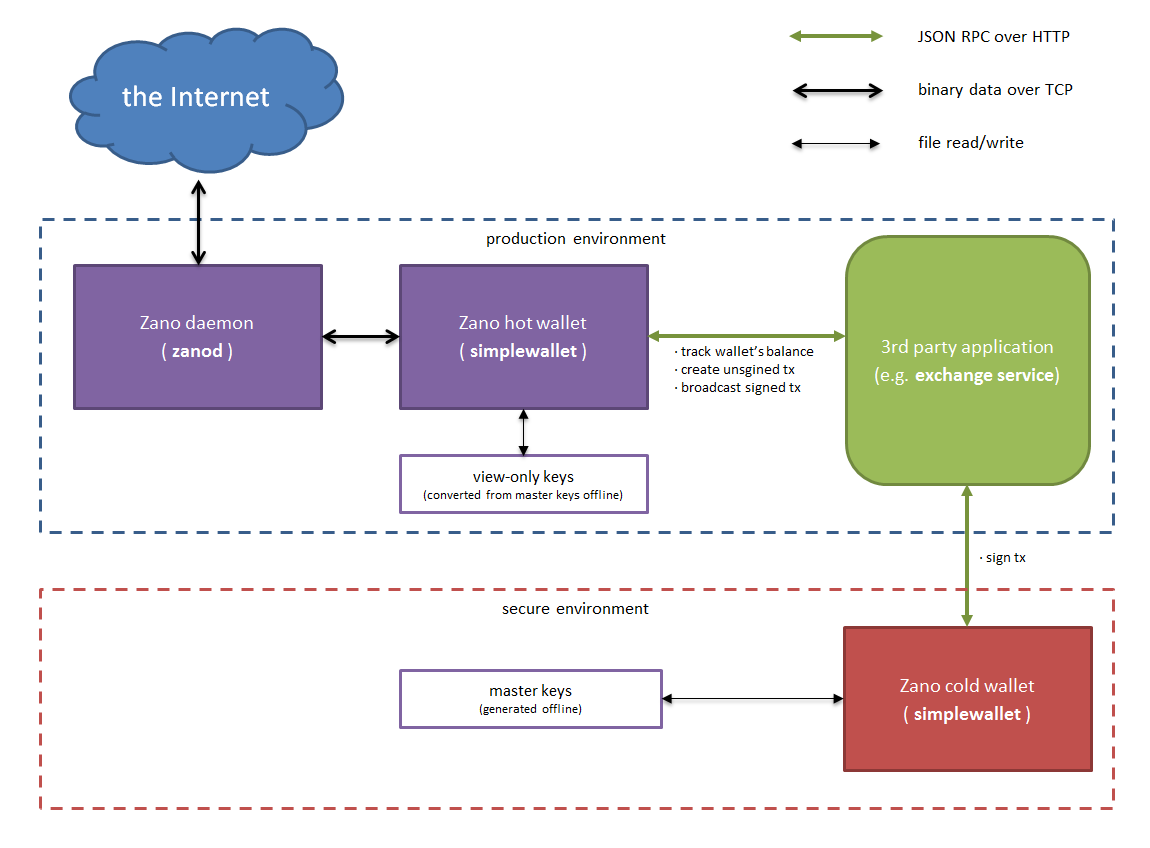
Zano as a CryptoNote coin uses two key pairs (4 keys) per wallet: view key (secret+public) and spend key (secret+public)
So-called "hot wallet" (or watch-only wallet) uses only view secret key. This allows it to distinguish its transactions among others in the blockchain. To spend coins a wallet needs a spend secret key. It is required to sign a tx. Watch-only wallet doesn't have access to spend secret key and thus it can't spend coins.
If someone has your spend secret key, he can spend your coins. Master keys should be handled with care.
Setup
-
In a secure environment create a new master wallet:
i. Start simplewallet to generate the master wallet:
simplewallet --generate-new-wallet=zano_wallet_master
(zano_wallet_master is wallet's filename and can be changed freely)
ii. Type in a password when prompted. An empty new wallet will be created.
iii. Open the new wallet again:simplewallet --offline-mode --wallet-file=zano_wallet_master
iv. In the wallet console, type the following command:save_watch_only zano_wallet_watch_only WATCH_PASSWORD
where WATCH_PASSWORD is the password for the watch-only wallet. You should see:Watch-only wallet has been stored to zano_wallet_watch_only
v. Typeexitto quit simplewallet. -
Copy zano_wallet_watch_only file from the secure environment to your production environment where daemons and the hot wallet are supposed to be run.
CAUTION: zano_wallet_master file contains master wallet's private keys! You may want to ensure it never leaves the secure environment.
- In the production environment start the daemon. Let it sync with the network if running for the first time and make sure it gets synchronized. Then, start the watch-only wallet:
simplewallet --wallet-file=zano_wallet_watch_only --password=WATCH_PASSWORD --rpc-bind-ip=RPC_IP --rpc-bind-port=RPC_PORT --daemon-address=DEAMON_ADDR:DAEMON_PORT --log-level=1 --log-file=LOG_FILE_NAME(see also the Introduction; for the first run you may use--log-level=0to avoid too verbose messages)
The setup is complete.
Example of a transaction cold-signing
In order to sign a transaction, follow these steps:
- Create a transaction using RPC transfer.
Because of using watch-only wallet keys for this instance of wallet application (please note passing zano_wallet_watch_only in i.3) a transaction will not be signed and broadcasted. Instead, an unsigned transaction will be prepared and returned back to the caller via RPC.
RPC example (please, see also transfer RPC description in "List of RPC calls" section above):
$ curl http://127.0.0.1:12233/json_rpc -s -H 'content-type:application/json;' --data-binary '{"jsonrpc":"2.0","id":"0","method":"transfer", "params":{ "destinations":[{"amount":1000000000000, "address":"ZxCb5oL6RTEffiH9gj7w3SYUeQ5s53yUBFGoyGChaqpQdud2uNUaA936Q2ngcEouvmgA48WMZQyv41R2ASstyYHo2Kzeoh7GA"}], "fee":10000000000, "mixin":0 }}'
{
  "id": "0",
  "jsonrpc": "2.0",
  "result": {
    "tx_hash": "",
    "tx_size": 0,
    "tx_unsigned_hex": "00-LONG-HEX-00"
  }
}
Unsigned transaction data retrieved in tx_unsigned_hex field should be passed to the secure environment for cold-signing by the master wallet.
NOTE. For testing purpose, you may also create a transaction using transfer command in simplewallet's CLI (command-line interface). The unsigned transaction will be saved into zano_tx_unsigned file.
-
Run the master wallet in RPC mode within a secure environment:
simplewallet --wallet-file=zano_wallet_master --offline-mode --rpc-bind-port=RPC_PORT --rpc-bind-ip=RPC_IP(note that the master wallet is running in offline mode and shouldn't have access to the Internet or Zano daemon). -
Using RPC sign_transfer sign the transaction using the master wallet.
RPC example:
$ curl http://127.0.0.1:12233/json_rpc -s -H 'content-type:application/json;' --data-binary '{"jsonrpc":"2.0","id":"0","method":"sign_transfer", "params":{ "tx_unsigned_hex" : "00-LONG-HEX-00" }'
{
  "id": "0",
  "jsonrpc": "2.0",
  "result": {
    "tx_hash": "864dc39fe1f1440651a9c2cc0585ba2f91498778bae86583d37fcc0b251aea4a",
    "tx_signed_hex": "00-LONG-HEX-00"
  }
}
A signed transaction retrieved in tx_signed_hex field should be passed back to the production environment to be broadcasted by the watch-only hot wallet.
NOTE: Please, don't sign more than one time the same "tx_unsigned_hex", as you'll get two transactions with different tx_id but spending the same key_images, which will lead to errors.
NOTE2: For testing purpose, you may also sign a transaction using sign_transfer command in simplewallet's CLI.
- Using RPC submit_transfer broadcast the transaction via watch-only wallet.
RPC example:
$ curl http://127.0.0.1:12233/json_rpc -s -H 'content-type:application/json;' --data-binary '{"jsonrpc":"2.0","id":"0","method":"submit_transfer", "params":{ "tx_signed_hex": "00-LONG-HASH-00" }'
{
  "id": "0",
  "jsonrpc": "2.0",
  "result": {
    "tx_hash": "864dc39fe1f1440651a9c2cc0585ba2f91498778bae86583d37fcc0b251aea4a"
  }
}
The transaction is successfully broadcasted over the network.
NOTE: For testing purpose, you may also submit a signed transaction using submit_transfer command in simplewallet's CLI.
Important note on watch-only wallets
Watch-only wallet is not able naturally to calculate a balance using only a tracking view secret key and an access to the blockchain. This happens because it can't distinguish spending its own coins as it requires knowing key images for own coins, which are unknown, as key image calculation requires spend secret key.
To workaround this difficulty watch-only wallet extracts and stores key images for own coins each time a signed transaction from a cold wallet is broadcasted using submit_transfer RPC. This data is stored locally in .outkey2ki file and it is required to calculate wallet's balance in case of full wallet resync.
It's important to keep this data safe and not to delete watch-only wallet's files (including .outkey2ki). Otherwise, watch-only wallet won't be able to calculate its balance correctly and the master wallet may be required to be connected online for recovering funds.
Please make sure, whenever you shutdown the watch only wallet - close it gracefully, use SIGINT, SIGTERM or ctrl+c and let it store the wallet state, or close ["store"] (https://docs.zano.org/docs/build/rpc-api/wallet-rpc-api/store/) wallet RPC method before you kill the simplewallet process.
If it happens that you lost or damaged outkey2ki or you see UNRECOVERABLE ERROR, wallet stops: m_pending_key_images > m_pending_key_images_file_container in the log, try restoring the watch only wallet as follows:
Restoring key images in the watch only wallet
-
Make sure you're running build 2.1.18.471 or more recent.
-
Backup all wallet files.
-
Stop all simplewallet processes in all environments.
-
Reset watch-only wallet using the following command:
simplewallet --wallet-file=zano_wallet_watch_only --resync-and-exit
Make sure it finished correctly. -
Move watch-only wallet file (
zano_wallet_watch_only) to the secure environment, where the master wallet file is located. -
In the secure environment run the following command (note the offline mode parameter):
simplewallet --offline-mode --wallet-file=zano_wallet_master --restore-ki-in-wo-wallet=zano_wallet_watch_only -
Enter master wallet's password and watch-only wallet password when prompted.
-
Make sure it finished successfully. You should see
Missing key images have been successfully repaired. -
Move
zano_wallet_watch_onlyandzano_wallet_watch_only.outkey2kifiles back to the production environment. Double-check you have moved both wallet file and .outkey2ki file.
Now watch-only wallet, once fully synced, should show the correct balance.
As a last resort you can always move your master wallet to the production environment, run it online (skipping --offline-mode), sync it and transfer all the funds manually to a newly created cold/hot wallets as described above.